Reflections on a Revolutionary Imaginary and Round Tables
The new always appears in the guise of a miracle
This is the prepared text answering the question “What do we really know about transitions to democracy?” for the General Seminar of The New School for Social Research, March 19, 2014.
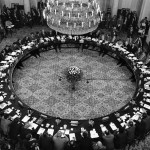
It was a quarter of a century ago, in 1989, that a new kind of revolutionary imaginary emerged, one that promises a new beginning, and demonstrates the possibility of comprehensive systemic change without bloodshed. Velvet or otherwise un-radical, this kind of revolution has become a site of tangible hope, a site in which words have power, where people regain their dignity, and realize their agency through instruments other than weapons. Negotiated revolutionis not an oxymoron, but it is still an extraordinary event, as dictatorships are by definition opposed to any spirit of dialogue and compromise. …
Remembering Tadeusz Mazowiecki
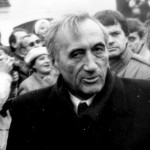
Tadeusz Mazowiecki, the first democratic prime minister of Poland, elected after decades of Communist rule, died on October 28.
In a widely popular weekly satirical puppet TV show, The Polish Zoo, which aired in Poland at the beginning of the 1990s, Mazowiecki was a turtle: sluggish and wise. (Among other central political figures were Lech Wałęsa, the president of Poland, as the lion, and a key post-Communist figure, Leszek Miller, as the spider.) Easily recognizable for his slow manner of speaking, Mazowiecki quickly became the symbol of peaceful, and rapid, democratic change.