EssaysLiberal Democracy in Question

In Support of PODEMOS

One of the most appalling and discouraging outcomes of the recent European elections has been the rise and affirmation of a number of far-right, xenophobic, and populist electoral parties in East and Northern Europe and in France. This has been largely the outcome of years of austerity policies and crisis, which have deteriorated the conditions of life for millions of people across the continent. In this discouraging scenario, the most promising novelty has been, in addition to the Syriza’s electoral victory in Greece, the birth and astonishing affirmation (7.9%) of a new organization: Podemos (Spain). Podemos was created only a few months ago, in March, by leftist activists associated with the 15-M movement, and inherited the spirit and organizational methods of the Indignados movement. It opposes austerity policies and defends the welfare state and social rights from the neo-liberal attack supported by both center-left and center-right coalitions across Europe. …

READ MORE →
EssaysRace

Rolezinho: Politics in Brazil’s Shopping Malls?

Since last December, Brazilian shopping malls have become the stage for a new style of youth gathering: the rolezinho. Roughly translated as “little excursions” or outings, the rolezinhos can be characterized as planned meetings (via social network) of a large group of youth from poor neighborhoods, with the intent of seeing each other, flirting, eating and drinking at McDonald’s, taking pictures to post on facebook, and simply having fun. This can be considered a collective action with direct links to at least two different issues that characterize contemporary Brazilian society.

First, rolezinhos cannot be understood without taking into account the almost nonexistence of public spaces for leisure and enjoyment. Coupled with the historic negligence of the Brazilian state to the population’s right to recreation, …

READ MORE →
Arts & DesignEssays

Aesthetic Community in Detroit

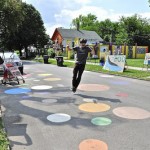
In the Huffington Post, author and community organizer Yusef Bunchy Shakur and co-author Jenny Lee write: “Detroit is modeling life after capitalism.” One of the ways this is happening is through the work of artists who are helping to envision what that life might look like. These artists are constructing what the French philosopher Jacques Ranciere calls an “aesthetic community.”

The aesthetic community of Detroit is more than simply a collection of artists and other creative types working in the same location. It’s a community of sense, as Ranciere expresses it, which operates on three levels.

The first level of aesthetic community is a certain combination of sense data — materials, forms, spaces, etc. — that constitute the work. In particular in Detroit, this often consists of using recycled castoff materials…

READ MORE →
EssaysLiberal Democracy in Question

Gezi Resistance: Re-claiming Democracy

A prominent political theorist, Judith Shklar, once said that the rule of law has become “a self-congratulatory rhetorical device” [1] used by the politicians, who try to legitimize whatever they do just by uttering the word “the rule of law.” I think we can say the same thing for democracy as well. In Turkey, every political party aims for democracy. Even the military suspended democratic politics with the claim of saving it. The Gezi protests are accepted as an instance of democratic politics, and Erdogan sees himself as the gatekeeper of democratic politics allowing no one in. What I am trying to do here is to provide a perspective from which we can analyze the AKP (the Justice and Development Party) and its relation to democracy on the one hand, and the impact of the Gezi, on the other. In doing this, I will draw on three thinkers and their ideas of democracy, namely Carl Schmitt, Claude Lefort and Jacques Ranciere.

READ MORE →
CapitalismEssays

On New Political Identities

Below is an interview of Simon Critchley by founder and editor of the UK-based quarterly print magazine STIR, Jonny Gordon-Farleigh. It appears in the Autumn issue of STIR under the title “An Interview with Philosopher Simon Critchley.” 

The most challenging task of recent times has been to find a common name — a new political identity — much like Proletariat was for the politics of the 19th and 20th centuries. In response, Simon Critchley’s work has explored political names such as the ‘indigenous’, and more recently ‘Anonymous’ — the name of those with no name — and Occupy’s slogan ‘We are the 99%’. In this interview Critchley argues that we need to create a new hegemony — the shaping of an alliance or common front — and also start a serious investigation into the history of political forms in general. With the remergence of general assemblies, affinity groups and spokecouncils, Critchley claims we should not be scared of the need to produce a formal political theory of these practices.

Jonny Gordon-Farleigh: Antonio Gramsci said, “the challenge of modernity is to live without illusions without becoming disillusioned”. In other parts of his writing he separates the intellect and the will — pessimism in the former and optimism in the latter. Is this the only way to get through the impasse of working for new alternatives within our political reality?

SC: Funnily enough, I sent that quotation, those very words to Thomas Hirschhorn, an artist who has been running a Gramsci monument in the Bronx under the auspices of the DIA Art Foundation. He’s built a fantastic, precarious, transient monument with a library and media centre with all sort of Gramsci-related activity. I sent him that quotation and it was put on the wall. The quotation is interesting because the point is not to become disillusioned while living without illusions. Maybe we could add another twist to that line of thought by saying the challenge of modernity is to live without illusions without becoming disillusioned but to accept that politics is the creation of an illusion that we know is an illusion. I think that illusion has a positive function and that it’s not all bad. It is not that we move from illusion to reality, necessarily. Politics is often about the creation of forms of positive illusion, which can stitch together a political movement and political front around a slogan or image. I don’t think we can just disregard illusions but we have to inhabit illusions while knowing they are illusions.

READ MORE →