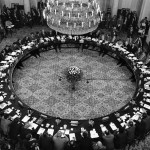
Reflections on a Revolutionary Imaginary and Round Tables
The new always appears in the guise of a miracle
This is the prepared text answering the question “What do we really know about transitions to democracy?” for the General Seminar of The New School for Social Research, March 19, 2014.
It was a quarter of a century ago, in 1989, that a new kind of revolutionary imaginary emerged, one that promises a new beginning, and demonstrates the possibility of comprehensive systemic change without bloodshed. Velvet or otherwise un-radical, this kind of revolution has become a site of tangible hope, a site in which words have power, where people regain their dignity, and realize their agency through instruments other than weapons. Negotiated revolutionis not an oxymoron, but it is still an extraordinary event, as dictatorships are by definition opposed to any spirit of dialogue and compromise. …
Sweeping the Sand Out of the Desert: From Verwoerd to Prawer
Ethnic cleansing in the Negev
The Prawer-Begin Plan was shelved. But the idea that you can forcefully transfer an indigenous population and determine where it can legally reside – looks and smells like a plan pulled from the dusty drawer of Hendrik Verwoerd, architect of Apartheid South Africa. And that didn’t work out so well.
Sadly, it was too early to celebrate the downfall of the Prawer-Begin Plan. The victory of suspending the Knesset vote following the the “day of rage” protests on November 30 was short lived. The dark threatening cloud of ethnic cleansing still hovers over the Negev’s Bedouin population. Nevertheless, Prawer’s suspension was the culmination of a grassroots mobilization that took months, years actually, to climax and grab public attention. It was an historical achievement.
The good news is that for the first time, the Jewish Israeli public woke up to the sound of a clear, well articulated and well organized Bedouin-led resistance movement…