EssaysFeatureFirst DraftsO.O.P.S.

The Thick Line

On the impossibility of coming to terms with a dark past

READ MORE →
EducationEssaysLiberal Democracy in QuestionSex & Gender

Four Ways African Universities Should Support Democracy

African universities need to redefine themselves and with greater urgency pursue a more vigorous democratization mission of their societies, given the spectacular failure of political leadership in the region to build quality democracies.

The challenge for African countries is how to mold democratically based models of citizenships in countries and regions where the political cultures are markedly undemocratic, even if governing parties, leaders and individual citizens may often profess embracing democracy. …

READ MORE →
EssaysIn DepthPsyche

The Discarded and the Dignified – Part 6

From the Failed Witness to “You are the Eyes of the World”

Embodying the third

Returning to the beginning of this essay, I have tried to suggest how we might view the embodied rather than dissociated self state as part of the reconstruction of the third in the wake of trauma. In her discussion of the Gugaleto Seven case Gobodo-Madikizela (2013) described the interactions between the perpetrator and the victims’ mothers as becoming very intimate. Thus the mother of the slain sons spoke of feeling the pain in her womb — the women and the perpetrator spoke of being parents and son. In expressing his remorse to them, the perpetrator addressed them as his mothers. …

READ MORE →
EssaysIn DepthPsyche

The Discarded and the Dignified – Parts 4 and 5

From the Failed Witness to “You are the Eyes of the World”

Witnessing as repair of the moral third

To imagine a way out of the binary of deserving and discarded requires envisioning a world governed by the third, in which our attachment to all beings as part of the whole is honored as real. That vision of social attachment is a condition of the ethical position of the third, and it is central to Ubuntu, the South African tradition that so deeply informed the Truth and Reconciliation Commission. As defined by Desmond Tutu, Ubuntu means: “A person is a person through other persons… ‘my humanity is caught up, is inextricably bound up in yours.’…a person with ubuntu …has a proper self-assurance that comes from knowing that he or she belongs in a greater whole and is diminished when others are humiliated or diminished, when others are tortured or oppressed” (Tutu, 1999, p. 31). Our humanity depends on reciprocal recognition of each other and of our ineluctable attachment. …

READ MORE →
EssaysIn DepthPsyche

The Discarded and the Dignified – Part 3

From the Failed Witness to “You are the Eyes of the World”

Failed witnessing: The Drowned and the Saved

The pivotal function of the moral third in relation to collective trauma is constituted by the acknowledgment of violation by the others who serve as witness. At a social level this role is played by the eyes and voice of the world that watches and upholds what is lawful by expressing, at the least, condemnation and indignation over injustice and injury, trauma and agony endured by the victims. The suffering or death of the victims is thus dignified, their lives given value. Their lives are worthy of being mourned, as Butler (2004) termed it, they are grievable lives. In other words, they are not simply objects to be discarded. Given the state of media proliferation, victims the world over know whether their suffering is seen and regarded; they can ask in despair, Why is no one paying attention as we die here? …

READ MORE →
EssaysIn DepthPsyche

The Discarded and the Dignified – Parts 1 and 2

From the Failed Witness to “You are the Eyes of the World”

In this paper I make an effort to blend with my theoretical perspective some of my experience traveling in many parts of the world to places where my colleagues are struggling with the effects of violence and collective trauma either in the present or its aftermath. In addition to psychoanalytic thinking I will bring some of my experience with dialogue in the Middle East to bear on these issues.[1] This represents an effort to show the possibilities for applying psychoanalytically derived concepts to social phenomena, and suggest ways in which recognition theory can be used to grasp deep psychological structures within both collective and individual processes. …

READ MORE →
EssaysLiberal Democracy in Question

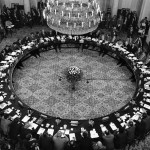
Reflections on a Revolutionary Imaginary and Round Tables

The new always appears in the guise of a miracle

This is the prepared text answering the question “What do we really know about transitions to democracy?” for  the General Seminar of The New School for Social Research, March 19, 2014.

It was a quarter of a century ago, in 1989, that a new kind of revolutionary imaginary emerged, one that promises a new beginning, and demonstrates the possibility of comprehensive systemic change without bloodshed. Velvet or otherwise un-radical, this kind of revolution has become a site of tangible hope, a site in which words have power, where people regain their dignity, and realize their agency through instruments other than weapons. Negotiated revolutionis not an oxymoron, but it is still an extraordinary event, as dictatorships are by definition opposed to any spirit of dialogue and compromise. …

READ MORE →
EssaysLiberal Democracy in Question

Egypt’s Constitutional Mess and Solutions from South Africa

Of the many important lessons the Egyptian people might take away from their 2014 constitutional referendum, three certainly stand out in stark relief: first, that the military owns the product of the plebiscite and must also own the political consequences; second, that no constitution or government will enjoy true legitimacy without a national reconciliation effort; and third, that the pathway out of Egypt’s transitional morass might in fact begin at the other end of the continent in South Africa.

When the government of ousted Egyptian president Mohammed Morsi sent its constitution to a public referendum in December 2012, it would have been a tall order to find a more emblematic case study in how not to establish a democratically legitimate national charter. In a desperate effort to jam through a constitution that would ensconce its role in governance, the Brotherhood made several strategic blunders that virtually ensured the showdown that led to Morsi’s ouster: …

READ MORE →