EssaysLiberal Democracy in Question

A Post on Laughter and Remembering in Berlin

Diversity, tension, relief, and the Stolpersteine

“…and this woman in the chic coat: is she going to clean also?”

Responding to advertisements calling for people to “actively remember,” on November 9 and 10, 2013, in Berlin and other German cities, the commemorative Stolpersteine (or “the stumbling blocks”) were physically cleaned. The Stolpersteine are little brass plaques placed at the entrances of houses whose inhabitants, most often Jews, were deported and murdered in the Nazi period. This form of commemoration was initiated in 1993.

The cleaning of the plaques was itself commemorative, marking the events of the once-named “Reichskristallnacht” of 1938. Though taking place on November 10 and 11, and often in broad daylight, the infamous attacks on Jews in Germany and Austria are officially remembered in Germany on November 9 and commonly thought to have been only nocturnal. The attacks have since been renamed, in both state and popular language, as the “Reichspogromnacht,” or the November Pogrom, foregrounding the anti-Semitism at their core…

READ MORE →
EssaysLiberal Democracy in Question

Lenin’s Lost his Head: What’s Going On in Kyiv?

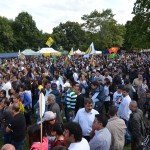
On Sunday, for the second time in two weeks, a half-million people gathered to protest against the government in Kyiv’s Maidan Nezalezhnosti (Independence Square) in an action dubbed on Twitter #ЕвроМайдан (EuroMaidan). Meanwhile, a short distance away, a smaller group of people toppled an eleven-foot statue of Vladimir Lenin, quickly removing its head and breaking the body up with a sledgehammer. The images of the latest Ukrainian protests are reminiscent of the Orange Revolution. The Maidan is again the site of a makeshift opposition camp complete with field-kitchen, portable toilets, hundreds of tents, a stage, and barricades all decorated with Ukrainian flags. Viktor Yanukovich and Russia have also reprised their roles as the main villains and targets of popular protest. While there is value in comparing the Orange Revolution and EuroMaidan, there are also important differences that make the solution to the present situation much more complicated and uncertain.

One common thread between the Orange Revolution and EuroMaidan is the contestation of Ukrainian identity…

READ MORE →
EssaysImaginal PoliticsLiberal Democracy in Question

Can Europe Learn from Latin America about History and Justice?

Can Latin America change European political memory? Can a long history of European silence be dealt with from across the Atlantic? The current investigations of Argentine courts into the crimes of the Franco dictatorship have brought these questions to the fore. As we have seen this week, many in Europe are not happy with this Third World « judicial intrusion » under the aegis of universal jurisdiction. …

READ MORE →
Essays

European Memory vs. European History: A Critical View From Estonia

This post was first published a few weeks ago. It is being featured today because of the very interesting comment by Maija Andersone-Spurina from Latvia and to encourage further discussion.  – J.G.

Since the fall of the Berlin Wall in 1989 and break-up of the Soviet Union in 1991, Europe has gone through unprecedented changes. Two decades later, there are still conflicting ideas about what Europe means and who belongs or should belong. Moreover, there still is a long shadow cast by the Holocaust, with distinct differences in how to live under the shadow. While there seems to be a tacit understanding in Western Europe of the importance of the Holocaust in twentieth century Europe, there is a rising focus on national suffering in many east European countries that marginalizes the European genocide. Memory and history are in tension, weakening understanding of national pasts and challenging the connection between the east and the west of Europe, weakening European unity.

READ MORE →