Populism, Representation, and Sanders
A Reply to Mueller
In a recent article published on Public Seminar, Jan-Werner Mueller affirmed that populism is by its very nature not only anti-elitist, but also anti-pluralist: “Populists claim that they, and only they, represent the people.” He then attacked the undemocratic tendency populist politicians show when they lose the elections: they “begin to question the existing political institutions, which are obviously producing the wrong outcome, or even accuse the winners of fraud, as Donald Trump just did.” Of course, Mueller admitted, unsatisfactory electoral results will not prevent populists from speaking in the name of “real Americans,” but at that point, …
Global Sweatshops, Solidarity and the Bangladesh Breakthrough
The global apparel industry is a notorious sweatshop employer, with millions of workers laboring under terrible conditions in dozens of developing countries, making products sold in the Global North. This is an industry that was among the first to undergo the globalization of production. The vast majority of workers are young women. Thus this industry combines issues of international trade, race, gender and labor in a confluence of misery and oppression.
The reasons for sweatshop working …
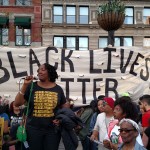
Black Lives Matter: The Politics of Race and Movement in the 21st Century
Understanding the movement and what it represents
Where should we begin in accounting for the rise of the movement for black lives?
The tragedy of 21st century America is that there are innumerable places one could begin. The grievances that have sparked the cry, “Black Lives Matter,” might be rooted in the killing of black bodies at the hands of police, …
Tunisia: Invisible Alienation, Visible Violence
A relational view of Tunisian youths
Analyzing the youth is notoriously a difficult task. How should we define this social group? Can we even speak of “the youth” in the singular? With regard to the Arab Uprisings (a phrase which I prefer to the loaded “Arab Spring”), many did not …
Letters From St. Petersburg, Part I
Social justice in the Maidan movement in Ukraine
Many researchers analyze the Maidan movement as a part of recent waves of protests shaking the world time and again. However, despite the similarities behind all these movements such as populist identities, anti-state agendas, and more, there is one crucial difference between the movements in the post-socialist world and protest movements in other countries – this difference concerns the social climate. …
The Mastery of Non-Mastery
A report and reflections from Kobane
As I write, the plug is being pulled on the steady-state.
Violence and tragedy take revenge on humanity through routinization. Sooner or later we become immune.
But is there a reverse process, such as Freud writes about in Beyond the Pleasure Principle, where the nightmare recurs so as to provide the anxiety that would have …
Women in the Rulings of the African Commission on Human and People’s Rights
Moving beyond the single story
After a long battle with the mainstream of human rights discourse and institutions dating from at least the era of the League of Nations, feminists organized in a transnational movement [1] have succeeded in placing women’s issues at the centre of human rights debates.
Here I want to take a step back from celebrating these achievements and ask: if women are now part of the transnational discourse on human rights, who are these women? How do transnational human rights institutions represent them? Or, put in other words, who is the female subject of transnational legal discourse and what gendered harms are made visible in this arena? …
The Plight of Greek Higher Education
Greek higher education has been, for the past four years, under a double attack, both by crippling austerity-induced budget cuts and by an attempt to accelerate the imposition of aggressively neoliberal reforms towards an entrepreneurial model of higher education.
To understand the importance of these processes, we must take into consideration the role of higher education in Greece as a contested terrain of social struggles. For a long time one of the basic forms of upward social mobility, access to a public higher education was considered at the same time a basic social right and something worth fighting for, both individually and collectively. …
Adding Injustice to Injury
One year on from the Gezi Park protests in Turkey
Our colleague, Zeyno Ustun, is back in Istanbul this month. We corresponded about the situation there on the occasion of the anniversary of the Gezi protests. She reports political paralysis with maximum police presence and sent a report from Amnesty International that she judges to summarize the situation accurately. Zeyno came across the following piece in Revolution News. It is re-posted here with permission. –Jeff Goldfarb
The repression of peaceful protest and the use of abusive force by police continues unabated one year after the Gezi Park protests.
Across Turkey, more than 5,500 people have been prosecuted in connection with the Gezi Park protests. …