“All My Life I Have Been a Woman” and Other Excerpts
About language, our society, madness…
Leslie Kaplan read the following excerpts from her plays after she gave the eighth William Phillips lecture on November 6, 2013 at Theresa Lang Student and Community Center/Arnhold Hall of The New School.
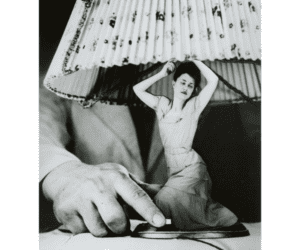
all my life I’ve been a woman
a woman
all my life
does that sentence seem
odd to me
Writing Moves the Sky
“To write is to jump outside the line of the assassins.” - Franz Kafka
First of all I would like to thank the New School, and Edith Kurzweil who invited me to this eighth William Phillips lecture and gave me the opportunity to come to the prestigious New School.
My father Harold Kaplan was a great friend of William Phillips, who published his first short story, The Mohammedans, in Partisan Review, in 1943, and later his Paris Letters, and many other pieces, and I always heard about Partisan review and William Phillips at home.
I was born in Brooklyn, in 1943, but brought up in Paris. Before the war, my father was studying French literature at the University of Chicago where he had a scholarship. He started working for the radio in 1942, in The Voice of America (La voix de l’Amérique), with André Breton and Pierre Lazareff, and afterwards was sent to Algiers, where he was when I was born…
What is Shakespearean Tragedy?
An excerpt from ‘What is Shakespearean Tragedy?’ forthcoming in The Oxford Handbook of Shakespearean Tragedy
The question ‘What is Shakespearean Tragedy?’ can understandably prompt one to start listing distinctive features of various plays by Shakespeare — as if a successful enumeration of its characteristics would amount to an understanding of the genre….
…However, rather than approach Shakespearean tragedy as the sum-total of certain features or “facts,” or as a generic object of study, I propose that we see Shakespearean tragedy as a discrete form of art — as the birth of a distinctive art form, the same way we think of ‘painting on canvas’ or ‘symphonic music’ as art forms that arrived on the world stage at a particular place and time.[i] Whereas a ‘genre’ purports to be a collection of objects that share common, taxonomically graspable features or techniques, there is no exhaustive list of features that ‘add up’ to Shakespearean tragedy – since, for a start, it is up to us to discern, decide, or debate, what will even count as features of this art form. Moreover, if Shakespearean tragedies all shared certain inherent, generic characteristics, then it would be difficult to distinguish between Macbeth and Hamlet and Othello –