Proclaim The New School a Sanctuary Campus for Undocumented Students
An Open Letter to President Van Zandt and Provost Marshall
No Border Police, No Border Problems
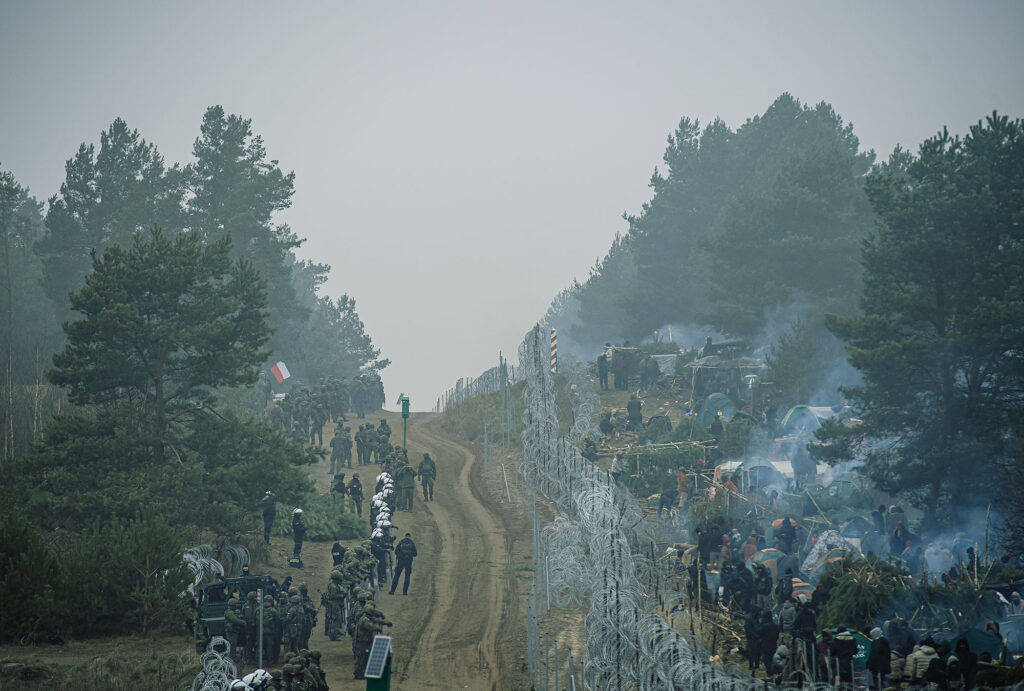
Most of the debate about the European refugee crisis revolves around whether the responsibility of handling them belongs to European institutions or to individual nation states, and, if the latter, which among them: the first country of entry (as the Dublin regulations established) or some other country. In this brief intervention, I would like to suggest that this is a false dilemma: in terms of citizenship, the European Union is dependent on the nation states that comprise it and thus, as a whole, Europe, as a political organization, is still largely dependent on their underlying logic. But the states are incapable of handling the crisis precisely because they are the very source of it.
I will be using “migrant” and “refugee” interchangeably. As the summer approaches, and quick rubber-boat rides become easier to access, Europe will again witness an intensification of the economic migration from the North African coast, …
We Refugees
In 1943 Hannah Arendt published a short essay in the Jewish periodical “The Menorah Journal” entitled We Refugees. She described in it a widespread refusal among Jews who had escaped the Nazis to call themselves “refugees.” Having lost everything — their occupation, their language, their family — they were eager to adapt to their new country as quickly as possible and to become “normal” citizens. Arendt thought that this assimilation strategy was doomed to failure, because it ignored the fact that the European model of the nation state is structurally dependent upon the fabrication of stateless and displaced persons. Instead, Jews should remember what made them special precisely as refugees. Refugees, she wrote, are “the vanguard of their peoples,” since for them history was no longer “a sealed book.” They have already experienced and recognized what to others has only become obvious today, in the era of globalization: the violence, fragility, and historical obsolescence of a territorial understanding of citizenship. …
Refugee Crisis and European Shame
On fences and fronts
If we had to describe the European Union’s response to the current refugee crisis with a single word, that word would be “chaos.” If we could use two words, the second word would be “shame,” necessary to refer to what European leaders and technocrats should feel upon reading the statement released by Doctors Without Borders (Médecins Sans Frontières, MSF) on March 22, 2016, announcing that the humanitarian organization would cease all activities connected to Moria, the main camp in the Greek island of Lesvos, where refugees are registered and fingerprinted before being relocated or deported. As Marie Elisabeth Ingres, MSF head of mission in Greece, said, ““We made the extremely difficult decision to end our activities in Moria because continuing to work inside would make us complicit in a system we consider to be both unfair and inhumane …
On Leaving
A meditation on the price of opportunity
Today I felt it when I saw the snow.
I hadn’t left the apartment in two days and had been watching television and aimlessly browsing the Internet, procrastinating and avoiding the cold. I turns out that I avoided it so well that for a couple of moments I forgot about how cold it is out there. And I forgot about the snow. But then I looked out the window and saw that “landscape” of pure concrete and white and I felt it… my phantom pain. My new life companion. …