EssaysLiberal Democracy in QuestionThe Left

The War on Fascism

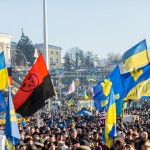
By my title,“The War on Fascism,” I do not mean the war between the US, the Soviet Union and Great Britain, on the one hand, and Nazi Germany, Mussolini’s Italy and imperial Japan on the other, the war that took place between 1939 and 1945. Rather I mean an unspoken war on the concept of fascism that increasingly characterizes our understanding of World War Two and informs discussion of contemporary problems, such as Ukraine. Although the term “fascism” is still in use today, it generally refers to real or supposed dictatorships, such as those of Saddam Hussein or Vladimir Putin, and has lost its original connotation, that of an authoritarian but still capitalist state. Because the original meaning of “fascism” was aimed not at dictatorship, but at the relation between dictatorship and private property and market power, the term had a critical or self-reflective character. Understanding the loss of this character can help us understand the history by which present political discussions, for example those concerning Putin, have become impoverished. …

READ MORE →
EssaysIn DepthLiberal Democracy in Question

Against Anarchism

For Edward J. Snowden and Chelsea Manning (formerly Bradley): Heroes of transnational publicity — in gratitude and with admiration.

One strategy for reimagining public sphere theory in the current conjuncture is neo-anarchism. Distrustful of global governance institutions, and of the expert networks entangled with them, this approach looks to anti-systemic movements as agents of transformation. Valorizing the independent militancy of Occupy, WikiLeaks, and the World Social Forum, it affirms efforts to build counterhegemonic centers of opinion and will formation, far removed from circuits of institutionalized power. Aiming to counter the hierarchical logic of administrative rule, it seeks to reconstruct public sphere theory in a way that gives pride of place to autonomous direct action by subaltern counterpublics and “strong” (decision-making) publics in civil society. Where else, after all, are we likely to find democratizing forces that can advance the theory’s ideals under current conditions?

READ MORE →