EssaysMedia/Publics

Amusing Ourselves to Life

I am in mourning and in withdrawal. I am losing my two nightly sanity fixes, Stephen Colbert and Jon Stewart. I’m left with my morning fixes: running, swimming and cycling. Sleeping will become more of a problem. I published this piece a number of years ago in Deliberately Considered. I might want to expand on it, exploring the importance of televised political satire and the American social condition. 

Neil Postman was a famous media critic. He thought that the problem with television was not its content but its formal qualities as a medium. It presented a clear and present danger. …

READ MORE →
CapitalismEssays

An Interview with Lance Taylor on Inequality

In a new paper for the Institute For New Economic Thinking’s Working Group on the Political Economy of Distribution, economist Lance Taylor and his colleagues examine income inequality using new tools and models that give us a more nuanced — and frightening — picture than we’ve had before. Their simulation models show how so-called “reasonable” modifications like modest tax increases on the wealthy and boosting low wages are not going to be enough to stem the disproportionate tide of income rushing toward the rich. Taylor’s research challenges the approaches of American policy makers, the assumptions of traditional economists, and some of the conclusions drawn by Thomas Piketty and Larry Summers. Bottom line: We’re not yet talking about the kinds of major changes needed to keep us from becoming a Downton Abbey society.

READ MORE →
CapitalismEssaysThe Left

Seven Steps toward Enlightenment: The Case of the French Killings

When a crystal breaks, it breaks along lines of pre-existing weakness. Thus traumatic assaults, like the one in Paris, can serve as X-rays into the body politic that endures them. Certainly, the US invasion of Iraq, a response to 9/11, serves as a paradigm case of how a terroristic attack can provoke the blind aggressivity otherwise obscured and disguised in the self-professed guarantor of world peace. By examining the range of responses to the massacre at Hebdo, we can learn something more about ourselves, and perhaps correct our mistaken stance. In my view there are seven levels of response to these attacks, each a mixture of ideology and truth, progressing closer and closer to something comprehensive and just, albeit also elegiac and incomplete. …

READ MORE →
EssaysLiberal Democracy in Question

The Old Patterns of the New Afghan Democracy

The Ghani-Abdullah Agreement and national and international stability in historical perspective

After a long electoral process, on September 27, 2014, Ashraf Ghani was sworn in as the Afghan president. The arrangements to grant him that office, which was earned in a controversial election, were not easy, because it forced a generous conciliation with Abdullah Abdullah, Ghani’s chief rival. Abdullah was granted the role of chief executive of the government, a sort of Afghan Prime Minister.

As Michael Keating points out, this is a blow to the trustworthiness of the electoral process, which serves precisely to avoid this sort of agreement among elites. …

READ MORE →
CapitalismEssaysThe Left

Climate Change and the New Synthesis

Is green the new red?

I completed my undergraduate studies at a small liberal arts college literally in the middle of a field somewhere between the bustling urban center of Cleveland and the depressed industrial ruins of my hometown, Youngstown. My alma mater was surrounded by acres of farmland, bodies of water, Amish communities, and the occasional rural-suburban housing development. Nothing much caught my eye during my commute except for the treacherous dips and twists along the sparsely populated main road I followed, which constantly threatened to re-route my aging Honda Civic into a tractor-dug ditch or a clutch of untouched trees.

Until one day, just crossing out of the corona of campus into the deep space of rural Ohio, I noticed a sign in a yard. “Green is the New Red,” it proclaimed, illustrated by a picture of a pleasantly green pine tree juxtaposed with an ominously red hammer and sickle. …

READ MORE →
EssaysLiberal Democracy in QuestionRace

Cop Violence and the Order of Urban Terrorism

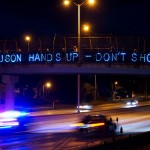
Immediately after Ferguson, MO cop Darren Wilson murdered unarmed 18-year-old Michael Brown on August 9, 2014, the city’s police mounted a show of militarized power that represented the rising tide of police-state terrorism in growing numbers of urban communities throughout the United States of America. Treating the community as a war zone, the cops occupied the streets, ostensibly to protect the city from the violence of black protestors. Rather, the militarized cop presence in the city of Ferguson only served to exacerbate community anger, outrage, and resentment. Young Brown’s parents, Leslie McSpadden and Michael Brown, Sr., were left to grieve for their son, who was left dead in the street for four hours. Since the murder of Michael Brown, killer cop Darren Wilson has not been seen in public, nor has he been charged with a crime; rather, he has been allowed to walk free and has gone into hiding. …

READ MORE →
EssaysLiberal Democracy in Question

Obama Channels Reagan in Estonia

In the days leading up to President Obama’s state visit to Estonia on September 3rd, the eve before the NATO summit meeting in Wales, details of his schedule, travel plans and meetings were meticulously scrutinized. As streets closed and helicopters circled, the contrast between the heavy security surrounding the Commander in Chief and his message of freedom couldn’t have been starker. Obama’s visit dramatically underscored the complex relationship between freedom and security in a post-9/11 world. …

READ MORE →
EssaysMedia/Publics

Israeli Hasbara, the Breakdown in Negotiations, and the Consequences

At this point, we can say that things are more or less over: President Obama announced on Friday that the American government is abandoning the Israeli-Palestinian negotiations, as neither side has been ready to make “tough decisions.” Basically, Obama was repeating what Secretary of State Baker once said to Israeli Prime Minister Shamir, following an earlier collapse of attempted peace negotiations: “Give us a call if you decide to get serious.” In response, Netanyahu’s office has already complained about the “soft” treatment that the Americans are allegedly giving the Palestinians.

Immediately, the Zionist regime (not my term: that’s how this administration defines itself) has initiated a hasbara campaign — basically, a PR attack — directed at the Israeli public. (“Hasbara,” literally, “explanation,” is the semi-official code in Israel for its propaganda efforts.)…

READ MORE →
EssaysThe Left

What’s Left?

A response to Jeremy Varon

Jeremy Varon’s interesting and important response raises three questions: 1) What do we mean by a “Left”? 2) How are we to understand the New Left’s break-up and, specifically the relation of the women’s movement to that break-up and 3) How are we to evaluate the Left today? Let me start with the third and work backwards.

I do not believe we can properly speak of a Left today. Jeremy’s view of a plurality of different movement working independently but parallel to one another avoids all the important questions. A Left needs coherence and direction. It needs leaders, organizations, its own counter public-spheres, some sense of the values that distinguish it from the mainstream. It needs a coherent analysis of such basic ruling class institutions as the Democratic Party, the universities and the so-called public sphere. Obviously I am not advocating a vanguard party, or a mass party of the Debsian sort. But to speak of the huge diversity of present protest movements that might be termed progressive as a Left stretches the term beyond reason. …

READ MORE →