Call For A Yell-Ceasefire Around The Polish Pogroms
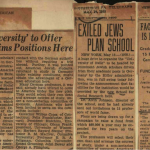
A few weeks ago at 7/9 Planty Street in Kielce, Poland, we of the Jan Karski Society launched a permanent exhibition devoted to the Kielce pogrom, a tragedy suffered by a local community of Holocaust survivors for whom that city became a place, not of peace and security, but of death, pain, suffering, and deep wounds. The Polish neighbors of these victims, instead of providing help, had been their tormentors.
The location of the exhibit was an obvious choice: …
The Tragic, Enduring Relevance of Arendt’s Work on Statelessness
While Hannah Arendt is most known for her reflections on totalitarianism and the banality of evil, eighteen years of statelessness (1933-1951) brought her philosophical questions of how one might be at home in the world into sharp relief. The fact that she was Jewish and German during the first half of the twentieth century profoundly influenced her life and writing. Given today’s refugee crisis, Arendt’s work is being examined anew in order to understand the ways in which mass statelessness has influenced the world since the twentieth century. As historian Jeremy Adelman wrote in The Wilson Quarterly: “Arendt’s voice is one we can turn to as we grapple with the spread of statelessness in our day. Camps and pariahs are still with us.” …
Homonationalism, Heteronationalism and LGBTI Rights in the EU
This year’s pride marches in Europe have taken place under the shadow of a threat, compounded by the recent terrorist attacks in Western Europe (Paris, Brussels and now Germany) and the slaughter at Pulse nightclub in Orlando. We have been urged not to give in to fear, while at the same time we’ve been told that undisclosed security precautions are being taken. The route of the Paris pride march was drastically shortened, supposedly for security reasons. It’s not clear whether the attack in Orlando was motivated by religious fundamentalism or was more the product of anger and anguish about the attacker’s life and sexuality. Either way, it could be just a matter of time before a similarly murderous anti-LGBTQI attack takes place in Europe. …
Queer Reflections On A Summer Of Violence: Surviving Orlando Without Alibi
In a June 12, 2016, Op-Ed (“The Scope of the Orlando Carnage”) New York Times columnist Frank Bruni joined many pundits in cautioning against what he described as narrowly sectarian interpretations of the violence that was unleashed at Pulse nightclub in Orlando, Florida, on the previous evening. “Let’s be clear,” Bruni declared, responding to “complaints on social media” about the failure of the mainstream media and politicians to avow the homophobic motivations of the attacker, “this was no more an attack on L.G.B.T. people than the bloodshed at the offices of Charlie Hebdo in Paris was an attack solely against satirists.” Extending this curious analogy between satirists and queer people …
A Kurdish Paradox in Turkey’s Wine Country
It is June and I’m in Elazığ, a city of just over a quarter of million in eastern Turkey. Streets bustle with families and packs of young men clutching their tespih or prayer beads. It is a modern city, but at its height in the 1930s and 1940s, Elazığ served as an important administrative center for Turkish Republican rule in the east. In the last sixty-five years however, much of the city’s historical role of governance has evaporated. Hardly a single vestige of the city’s Ottoman or Republican past remains. Elazığ, I am told, has suffered much.
I am picked up from the airport by a colleague of mine, Bora, who knows the city well. He’s jovial and Kurdish, originally from a small village in between Mardin and Diyarkbakır, two large cities to the southeast of where we stand. We get in his car and drive into the countryside. …