Ernesto Laclau, 1936-2014
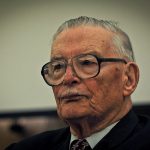
It is with great sadness that we learn of the death of Ernesto Laclau, the outstanding Argentinean political philosopher, at the age of 78. Ernesto had a heart attack in Seville where he was giving a lecture. He was the author of landmark studies of Marxist theory and of populism as a political category and social movement. In highly original essays and books he demonstrated the far reaching implications of the thought of Antonio Gramsci, probed the assumptions of Marxism and illuminated the modern history of Latin America, rejecting simplistic schemas linked to notions of dependency and populism.
After studying in Buenos Aires Ernesto came to Britain in the early 1970s, where he lectured at the University of Essex and later founded the Centre for Theoretical Studies. The Centre ran a very successful postgraduate programme, attracting students from around the world. In the 1970s Ernesto made his mark with his critique of the so-called “dependency school” of Latin American political economists such as Fernando Henrique Cardoso. …
Reflections on a Revolutionary Imaginary and Round Tables
The new always appears in the guise of a miracle
This is the prepared text answering the question “What do we really know about transitions to democracy?” for the General Seminar of The New School for Social Research, March 19, 2014.
It was a quarter of a century ago, in 1989, that a new kind of revolutionary imaginary emerged, one that promises a new beginning, and demonstrates the possibility of comprehensive systemic change without bloodshed. Velvet or otherwise un-radical, this kind of revolution has become a site of tangible hope, a site in which words have power, where people regain their dignity, and realize their agency through instruments other than weapons. Negotiated revolutionis not an oxymoron, but it is still an extraordinary event, as dictatorships are by definition opposed to any spirit of dialogue and compromise. …
John Dewey’s Encounter with Leon Trotsky
The 1930s was one of the one eventful and productive decades in Dewey’s life. He published more than a half dozen books including Logic: The Theory of Inquiry. It was during this decade that he sharpened his understanding of radical democracy and a renascent liberalism. He interrupted his scholarly work to travel to Mexico as the Chair of the Trotsky Commission — or to give its full title, “The Commission of Inquiry into the Charges Made against Leon Trotsky in the Moscow Trials.” …
Brazil, June 2013, Act II
What happened in June 2013 and what will happen in June 2014
Now that 2013 is over, it seems safe to say that the major event last year in Brazil was the series of demonstrations that took place all over the country in June. What triggered the protests was a small rise in the cost of public transportation. On June 1st, fares increased R$0,20 in São Paulo city. On June 13th, a group of university students was severely beaten by the military police on Avenida Paulista. Many journalists witnessed the beating. Most protesters were injured, and two journalists almost lost their eyes. The beating was broadcast on national television and across social networks. Brazilians were appalled with police brutality in São Paulo, and thenceforth demonstrations spread throughout the nation.
Police violence has been common in Brazil for many years, and has not been a big concern for most Brazilians. One has only to think of Captain Nascimento, an unorthodox police officer played by Wagner Moura in Elite Squad, the all-time biggest box office ticket seller in Brazilian cinema. …
Egypt’s Constitutional Mess and Solutions from South Africa
Of the many important lessons the Egyptian people might take away from their 2014 constitutional referendum, three certainly stand out in stark relief: first, that the military owns the product of the plebiscite and must also own the political consequences; second, that no constitution or government will enjoy true legitimacy without a national reconciliation effort; and third, that the pathway out of Egypt’s transitional morass might in fact begin at the other end of the continent in South Africa.
When the government of ousted Egyptian president Mohammed Morsi sent its constitution to a public referendum in December 2012, it would have been a tall order to find a more emblematic case study in how not to establish a democratically legitimate national charter. In a desperate effort to jam through a constitution that would ensconce its role in governance, the Brotherhood made several strategic blunders that virtually ensured the showdown that led to Morsi’s ouster: …
The Social Condition: Religion and Politics in Israel
Once I commit myself to a new theoretical project, I start realizing how my reading can illuminate it. Sometimes this involves a concerted effort. Thus these days I am re-reading Georg Simmel with an intuition that he can be a key theoretical guide in understanding the social condition. But sometimes this is just a matter of reading something of general interest and realizing that it contributes to my project. Thus I thought of my exploration with Iddo Tavory of the unresolvable dilemmas built into the social fabric when I was reading Nachman Ben Yehuda’s book, Theocratic Democracy: The Social Construction of Religious and Secular Extremism.
Ben Yehuda, my old friend and colleague, is studying in his book Jewish extremism in the Jewish state. He investigates deviance in the religious community as a way to analyze the conflict between the religious and secular in Israel. …
The Politics of Public Debt
Neoliberalism, capitalist development, and the restructuring of the state
This is the text of the Heuss Lecture (with audio of the Q & A below), delivered as part of the General Seminar series in the Wolff Conference Room of The New School for Social Research at 6 E. 16th. St. in New York on December 11, 2013.
From the 1970s on public debt increased more or less steadily in most, if not all, OECD countries, as it never had in peacetime. The rapid rise in public indebtedness was a general, not a national phenomenon, although in some countries, especially ones with low levels of inflation like West Germany, it began earlier than in others (Streeck 2011). In this essay I will emphasize the cross-national commonalities rather than the national specifics of the transformation of the “tax state” (Schumpeter 1991 [1918]) into a debt state and from there, at present, a consolidation state.[1] My argument focuses on the family of countries that adopted a regime of democratic capitalism, or capitalist democracy, after the Second World War, …
EuroMaidan Politics
Friends and Enemies in Ukraine
“The following video contains graphic content, which may be disturbing for some viewers,” says NYTimes.com about a video of the protests in Ukraine. Yes, politics — if by “politics” we do not mean debates of “experts” and TV celebrities who represent political parties — is disturbing, and not only in Ukraine.
Yet, in Ukraine, politics has come back. Hundreds of thousands of people have been on the streets for two months already protesting the government. What started in November 2013 as a protest against President Viktor Yanukovych’s decision not to sign the Association Agreement with the EU has very quickly turned into a protest against the entire regime, the whole system of power from the President to a local police officer.
The first violence used against the protesters on November 30 showed that the government hates to see the faces of those who do not like it. After two months of mass protests, …