Arts & DesignEssays

The Binding of Isaac – Roundtable

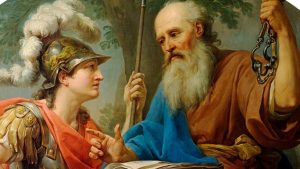
The Binding of Isaac, Akedat Yitzhak, continues to serve as a background for discussions of religion, politics, art and philosophy. This concise Biblical narrative, only 19 verses in length, has managed to set a model for thinking about obedience and sacrifice, secularism and politics, art and philosophy—and more.

In the recording below, Yael Feldman (Literary Criticism/Hebrew Studies, NYU), James Goodman (History/Writing, Rutgers), Jay Bernstein and I meet to discuss our different perspectives on the story.

READ MORE →
Multi MediaVideo

The Binding of Isaac – Roundtable

The Binding of Isaac, Akedat Yitzhak, continues to serve as a background for discussions of religion, politics, art and philosophy. This concise Biblical narrative, only 19 verses in length, has managed to set a model for thinking about obedience and sacrifice, secularism and politics, art and philosophy—and more.

In this recording, Yael Feldman (Literary Criticism/Hebrew Studies, NYU), James Goodman (History/Writing, Rutgers), Jay Bernstein (Philosophy, NSSR) and Omri Boehm (Philosophy, NSSR) meet to discuss their different perspectives on the story.

READ MORE →
CapitalismEssays

On New Political Identities

Below is an interview of Simon Critchley by founder and editor of the UK-based quarterly print magazine STIR, Jonny Gordon-Farleigh. It appears in the Autumn issue of STIR under the title “An Interview with Philosopher Simon Critchley.” 

The most challenging task of recent times has been to find a common name — a new political identity — much like Proletariat was for the politics of the 19th and 20th centuries. In response, Simon Critchley’s work has explored political names such as the ‘indigenous’, and more recently ‘Anonymous’ — the name of those with no name — and Occupy’s slogan ‘We are the 99%’. In this interview Critchley argues that we need to create a new hegemony — the shaping of an alliance or common front — and also start a serious investigation into the history of political forms in general. With the remergence of general assemblies, affinity groups and spokecouncils, Critchley claims we should not be scared of the need to produce a formal political theory of these practices.

Jonny Gordon-Farleigh: Antonio Gramsci said, “the challenge of modernity is to live without illusions without becoming disillusioned”. In other parts of his writing he separates the intellect and the will — pessimism in the former and optimism in the latter. Is this the only way to get through the impasse of working for new alternatives within our political reality?

SC: Funnily enough, I sent that quotation, those very words to Thomas Hirschhorn, an artist who has been running a Gramsci monument in the Bronx under the auspices of the DIA Art Foundation. He’s built a fantastic, precarious, transient monument with a library and media centre with all sort of Gramsci-related activity. I sent him that quotation and it was put on the wall. The quotation is interesting because the point is not to become disillusioned while living without illusions. Maybe we could add another twist to that line of thought by saying the challenge of modernity is to live without illusions without becoming disillusioned but to accept that politics is the creation of an illusion that we know is an illusion. I think that illusion has a positive function and that it’s not all bad. It is not that we move from illusion to reality, necessarily. Politics is often about the creation of forms of positive illusion, which can stitch together a political movement and political front around a slogan or image. I don’t think we can just disregard illusions but we have to inhabit illusions while knowing they are illusions.

READ MORE →
CapitalismMulti MediaVideo

Towards the Next Default Threat?

This week The New School’s Schwartz Center for Economic Policy Analysis (SCEPA) hosted three New School economists to discuss the economic and political fallout of the government shut down and the possibility of a default. Professors Teresa Ghilarducci, Rick McGahey and Christian Proaño discussed possible scenarios in case the United States would default on its debt, and the political economy of both the shutdown and the debt ceiling crisis. …

READ MORE →
EssaysIn DepthLiberal Democracy in Question

Against Anarchism

For Edward J. Snowden and Chelsea Manning (formerly Bradley): Heroes of transnational publicity — in gratitude and with admiration.

One strategy for reimagining public sphere theory in the current conjuncture is neo-anarchism. Distrustful of global governance institutions, and of the expert networks entangled with them, this approach looks to anti-systemic movements as agents of transformation. Valorizing the independent militancy of Occupy, WikiLeaks, and the World Social Forum, it affirms efforts to build counterhegemonic centers of opinion and will formation, far removed from circuits of institutionalized power. Aiming to counter the hierarchical logic of administrative rule, it seeks to reconstruct public sphere theory in a way that gives pride of place to autonomous direct action by subaltern counterpublics and “strong” (decision-making) publics in civil society. Where else, after all, are we likely to find democratizing forces that can advance the theory’s ideals under current conditions?

READ MORE →